Sofa Buying Guide: Find the Right Fit
Choose a sofa that fits your room and your life with practical guidance on dimensions, frames, cushions, and fabric.
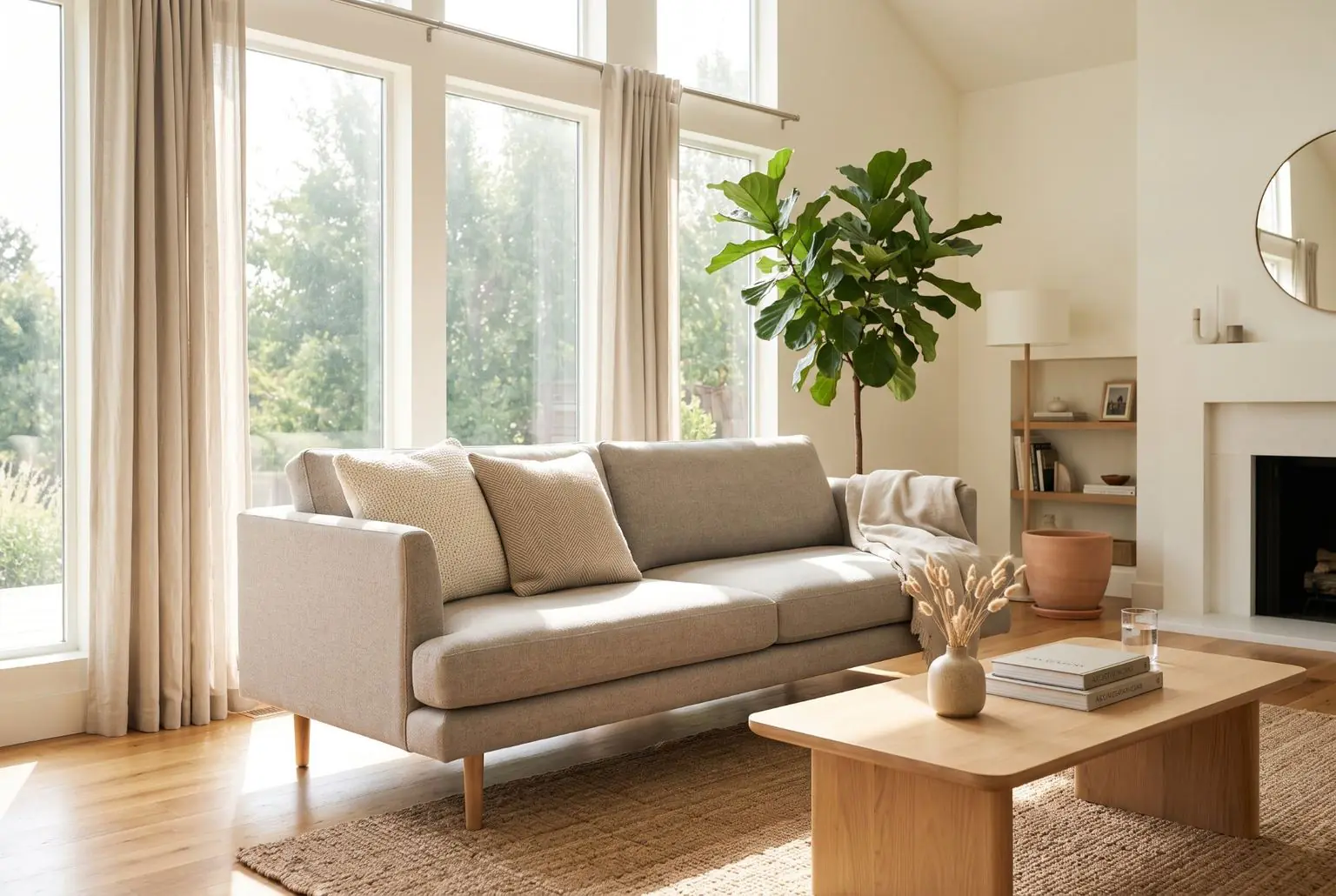
The hardest part of buying a sofa is not the color or the brand — it's whether the dimensions match your body, your room, and how you actually live. Spec sheets give you width and depth, but skip the six numbers that decide whether you'll love the sofa five years from now.
This guide walks through those six dimensions, then the build-quality numbers (frame, suspension, cushion density, fabric) that separate a sofa you'll sit on for a decade from one that sags in three years. If you are still measuring the room, start with living room dimensions and the sofa clearance guide.
The six dimensions that decide fit
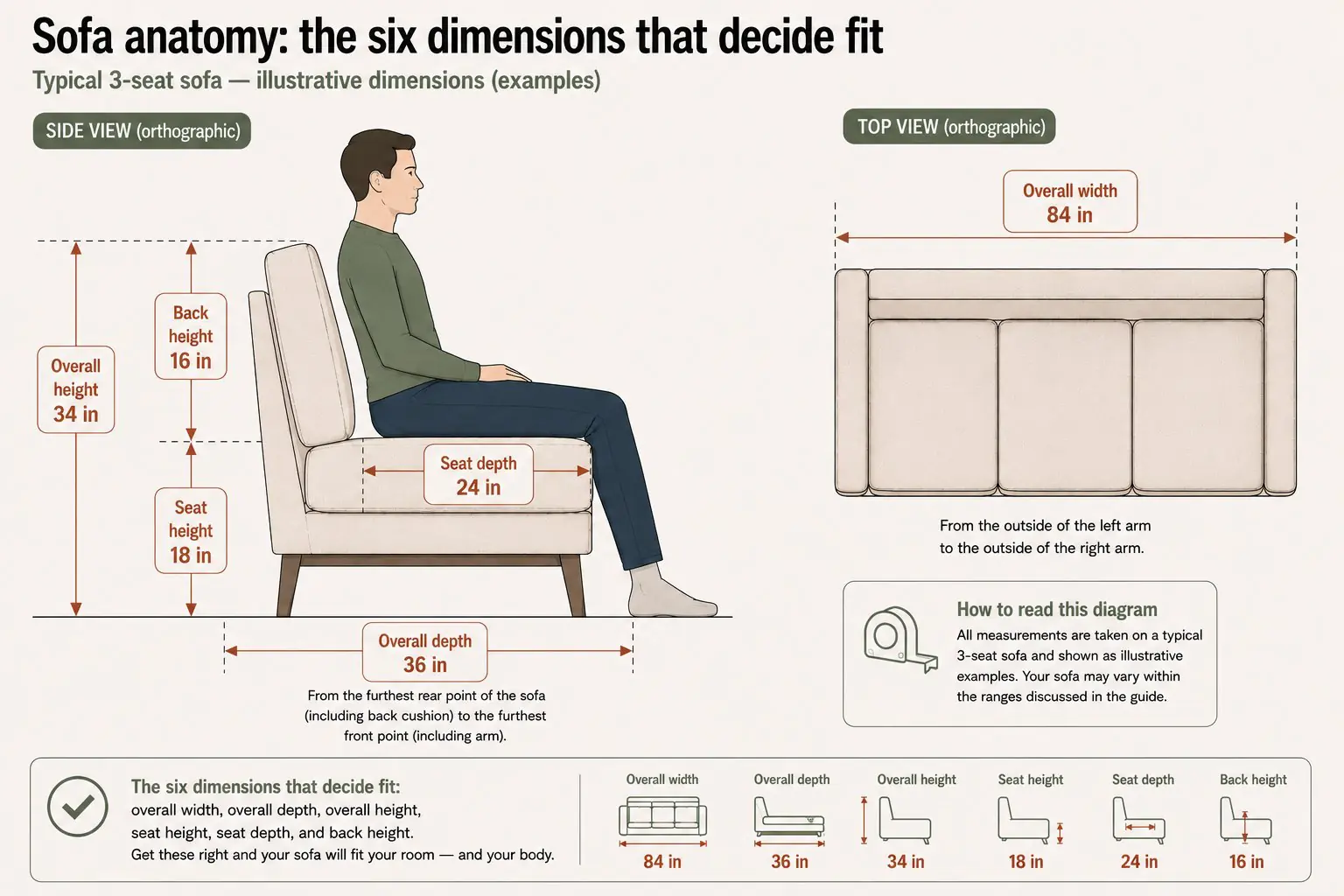
Every sofa has six numbers that matter more than its style. Get any one wrong and the sofa fails — too low to stand up from, too deep to sit upright, too wide for the door.
Overall width runs 70–90 in for a 3-seat (84 in is the most common), 60–75 in for a loveseat, and 100–140 in for a sectional. Overall depth runs 32–40 in for standard seats and 40–48 in for deep-seat loungers [1]. For a deeper breakdown of how overall width and depth translate to room fit, see the living room dimensions guide.
Overall height (floor to top of back) is usually 31–36 in. Seat height runs 17–19 in for standard sofas and 14–16 in for low-profile / lounge styles. Seat depth runs 22–24 in for upright seating, 26–28 in for standard comfort, and 28–36 in for deep-seat loungers. Back height runs 14–20 in. Arm height runs 22–28 in and should land at a comfortable height for leaning an elbow.
The simplest sizing rule: in a typical 10×12 living room, a standard 84×36-in sofa leaves room for a 48-in coffee table and 18-in clearance on every side — check our sofa spacing rules for the full 18/24/30 pattern.
Seat height and depth: match the people, not the showroom
Seat height should let you sit with feet flat on the floor and knees at roughly 90°. That means 17–19 in for most adults. Anything below 16 in is lounge territory and hard to stand up from; anything above 20 in feels like a dining chair and stops working as a sofa [2].
Seat depth decides whether you can sit upright with back support or sink into a lounging posture. 22–24 in fits upright sitting and works for shorter sitters. 26–28 in is the standard comfort range and suits most adults. 30+ in is deep-seat territory — great for tall people, less great for anyone under 5'6" who can't reach the back cushion without a pillow.
If you share the sofa with a partner and one of you is under 5'6" while the other is over 5'10", aim for 24–26 in seat depth. That's the overlap zone where both can sit comfortably.
| Sitter height | Seat height | Seat depth |
|---|---|---|
| Under 5'6" | 16–18 in | 22–24 in (upright) |
| 5'6" – 5'10" | 17–19 in | 24–26 in (most flexible) |
| 5'10" – 6'2" | 18–19 in | 26–28 in (standard) |
| Over 6'2" | 18–20 in | 28–36 in (deep-seat) |
Frame: kiln-dried hardwood or plywood, nothing else
Frame material is the single biggest durability predictor and the easiest to verify. Quality frames are kiln-dried hardwood (typically oak, ash, beech, or maple) — never softwood like pine, which warps. Acceptable second choice is 7+ layer plywood. Anything described as 'engineered wood', 'MDF', or 'particle board' is a budget frame that will loosen in 3–5 years [3].
Joinery matters as much as material. The four corners of the frame should be glued, doweled, and screwed (or dovetailed). Staples alone or just glue is a budget shortcut. Lift one corner of the sofa in the showroom — a quality frame feels solid, a budget frame creaks and twists.
Warranty is the cleanest quality signal. 10+ years on the frame is a confident manufacturer (Article, Joybird, Burrow, Castlery, Maiden Home, and most premium brands). Lifetime is even better but rare. A 1-year 'limited' warranty is a budget sofa.
Suspension: 8-way hand-tied is the gold standard, sinuous springs are fine
Suspension is what makes the sofa feel supportive and what stops it from sagging. Three options to evaluate:
8-way hand-tied springs: the gold standard — individual springs tied to the frame in eight directions. Heavier, more expensive, and excellent support. Found on premium sofas ($2,000+).
Sinuous (S-spring) springs: continuous S-shaped wires running across the frame. The mainstream choice — supportive, durable, lighter than 8-way. Found on most quality mid-range sofas ($800–2,000).
Webbing or elastic straps: fabric or rubber strips stretched across the frame. Light and budget-friendly, but they stretch out in 3–7 years and feel soft. Fine for occasional-use sofas, skip for daily use.
Sit down hard on the showroom floor model and stand up. If you can feel the frame hit the floor through the cushions, the suspension is too thin or the seat platform is too hard. A well-built sofa absorbs the sit without bottoming out.
Cushion fill: density over softness
Cushion density (not softness) is the durability number. Density is measured in pounds per cubic foot (lb/ft³). For foam cushions, the rules are simple:
1.5 lb/ft³ or below: budget foam. Soft out of the box, sags in 1–2 years.
1.8–2.0 lb/ft³: the standard range for quality sofas. Holds shape 5–8 years.
2.0–2.5 lb/ft³: premium. Holds shape 8–12 years. Feels firmer out of the box but softens with use.
2.5 lb/ft³ and above: very firm, sometimes described as 'hotel-style'. Longest life but the firmest feel.
Down, down-wrapped foam, or down-alternative poly blends are softer but require regular fluffing. They're more comfortable for short sits (TV, conversation) and less ideal for sleeping or extended lounging. If you want down comfort without the maintenance, look for a down-wrapped foam core — foam for support, down for the initial feel.
Fabric: Martindale and double-rub numbers
Fabric durability is measured in two ways depending on where you are. In the US, the double-rub count (Wyzenbeek method) is standard: 15,000+ is residential-grade, 30,000+ is heavy-duty / commercial. In Europe and on most international brands, the Martindale scale is used: 20,000+ rubs is residential-grade, 40,000+ is heavy-duty [4].
For a family sofa (kids, pets, daily use), aim for 30,000 double-rubs or 40,000 Martindale. For a formal living room sofa that's used twice a week, 15,000 / 20,000 is fine.
Fabric type matters as much as the number. Performance fabrics (crypton, sunbrella, performance velvet, olefin blends) resist stains better than natural fibers. Tight weaves last longer than loose weaves. Removable, washable covers are worth the upcharge if you have kids or pets.
Leather: full-grain is the most durable and develops a patina. Top-grain is the standard quality choice. Split-grain and 'bonded leather' are budget options that peel within 3–5 years — avoid bonded leather entirely.
Modular vs fixed: pick based on your staircase
Modular sofas (Burrow, Article, Castlery Modular, Lovesac) ship in pieces that lock together. The win is delivery: each box fits through a standard door and stairwell. The trade-off is the seams between modules — over time, the cushions between pieces may not sit perfectly flush.
Fixed-frame sofas are one piece (or two pieces for sectionals). Cleaner lines, no seam between cushions, but delivery is harder and may require white-glove service for upstairs apartments.
If you're in an upstairs apartment, a tight stairwell, or a building with a small elevator, modular is almost always the right call. If you have ground-floor access and a wide front door, fixed-frame looks better long-term.
For a complete picture of how all these dimensions and room size fit together, the full room-size reference walks through every major furniture category.
Builds worth comparing
Live listings showing what real wood legs, dense fill and a long review history look like.

Zinus Jackie Loveseat Sofa
52.7 × 32.14 × 34.45 in·4.2★ (1,626)
$460est. — confirm on Amazon
53 in wide with wood legs — wood stated on the listing.

DOPEDIO Chenille Loveseat Sofa (Beige)
71.25 × 33.07 × 36.6 in·4.3★ (1,052)
$340est. — confirm on Amazon
1,052 reviews at 4.3 stars, 71 in wide.
Prices are estimates captured in September 2026 — confirm the current price on the retailer's page before buying. As an Amazon Associate, FitsMySpace earns from qualifying purchases.
Related guides
Sources & References
- Furniture industry standard sofa dimensions (overall width 70–90 in for 3-seat, seat height 17–19 in, seat depth 22–28 in) — American Home Furnishings Alliance
- Ergonomic seat height and depth for adult sitting (knee angle 90°, seat height range 16–20 in) — Human Factors and Ergonomics Society
- Frame material and joinery standards for upholstered furniture (hardwood frame + glued/doweled/screwed corners) — American National Standards Institute (ANSI / BIFMA)
- Fabric durability standards — Wyzenbeek double-rub (US) and Martindale (international) abrasion resistance scales
Check it against your own room
Enter your exact width and length — the planner sizes every piece to your footprint and tells you instantly what fits.